“Compass for the Future”: Marking 10 Years of COCE, Our Global Code of Conduct & Ethics Connecting 70,000 People Worldwide
September 18, 2026
In an interview with a member of the team that drafted COCE and staff members responsible for its current promotion, we hear about the background to its creation, our initiatives over the years to ensure awareness of COCE in our operations worldwide, and the outlook for the next 10 years.

Takuya Fujimoto
Group Leader
Compliance Management Group
Compliance & Crisis Management Department

Eijiro Inoue
Compliance Management Group
Compliance & Crisis Management Department

Ayako Hinoue
Compliance Management Group
Compliance & Crisis Management Department
Not just following the rules, but doing what is right
The role of COCE, 10 years on from its establishment
The Toyota Tsusho Group has around 70,000 officers and employees in its consolidated operations at business sites in 130 countries worldwide. Although we are of different nationalities, speak different languages, and have different cultural backgrounds, we need to move forward together in the same direction. The compass that enables us to do that is our Global Code of Conduct & Ethics (COCE).
In its content, COCE addresses not just compliance but issues from safety and the environment to kaizen (continuous improvement) activities and human rights and DE&I. However, it consists of more than just a list of rules. It serves as a kind of compass for the future, guiding each of our officers and employees to act appropriately for the realization of our Global Vision to “Be the Right ONE” and in accordance with our corporate philosophy: “Living and prospering together with people, society, and the planet, we aim to be a value-generating corporation that contributes to the creation of prosperous societies.” In this way, it provides the set of values indispensable for operating diverse businesses on a global scale.
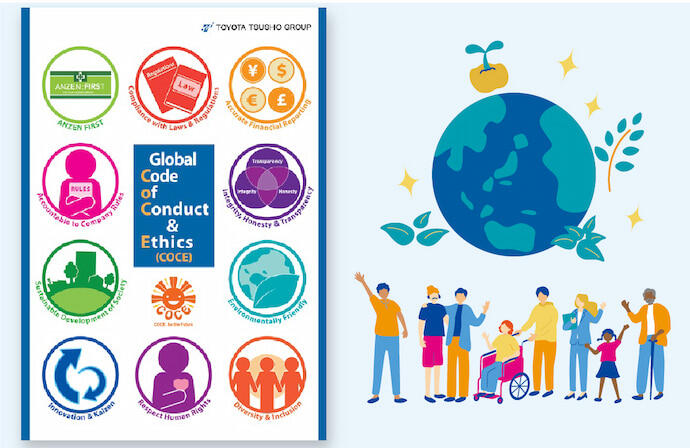
■ Global Code of Conduct & Ethics (COCE)
- 1We are committed to "ANZEN" to create a safe and healthy work environment.
- 2We will comply with all applicable laws and regulations; including anti-corruption, anti-trust and competition law, and trade laws and regulations.
- 3We are committed to accurate financial reporting.
- 4We are accountable for compliance with all company rules.
- 5We will act with integrity, honesty and transparency, and protect and develop trust among all stakeholders.
- 6We will contribute to the sustainable development of society.
- 7We will promote and pursue environmentally friendly corporate activities.
- 8We will add value through innovation and "Kaizen" (continuous improvement).
- 9We will respect human rights.
- 10We will embrace diversity and inclusion within our company and society.
Click here for the full text:
https://toyota-tsusho.disclosure.site/en/themes/15/
Ten years have passed since the establishment of COCE in July 2016. We continue to involve our officers and employees around the world in related awareness-raising initiatives. To hear about COCE’s journey so far and its outlook for the next ten years, we invited three members of staff to join us for a discussion: Eijiro Inoue, a member of the team that drafted COCE; Takuya Fujimoto, Group Leader of the Compliance Control Group; and Ayako Hinoue, who has a core role in activities to promote awareness worldwide.
Inoue: Before we started work on drafting COCE, the need had developed to create a foundation in our globally expanding business operations that would enable officers and employees worldwide to act on the basis of a shared set of values. We started by carrying out a survey to investigate how employees think about values and behavior. What emerged clearly was an internal culture in which staff acted in accordance with what their manager taught was right. But different countries also have different values and different ideas of right and wrong. We questioned whether it was acceptable to leave this judgment in the hands of individual officers and employees.
When we looked at other global companies, we found that many of them had established a code of conduct or a code of ethics. So we decided that Toyota Tsusho should also create a shared code that would integrate perspectives from around the world. To help us, we gathered a team from our global business sites.
Fujimoto: The people we approached were people who were trusted within their company. We selected regardless of job position by asking who was best placed to discuss ethical matters. For the discussions, we took the decision not to hire an interpreter. Instead, we asked all participants to communicate in English to make it easier to pick up nuances of meaning and sense how passionately they felt. Native speakers were to talk at a gentle pace using plain language so that participants who were not proficient in English could join in without feeling inhibited, and all opinions were to be respected. With these shared rules, we worked to create a space where everyone could express their opinion.
Inoue: We had these shared rules in place, but before starting, I remember we were worried that it would not be possible to bring all the different opinions together. Learning from the efforts of other companies and from the United Nations Global Compact, we started by giving free voice to the members of the team we had gathered. As expected, they responded robustly with a wide range of different opinions. We worked carefully to set them out in a logical order without imposing our own ideas, but finding words that spoke for the whole range of opinion was no easy task, was it?
Hinoue: Where I particularly felt the difference from Japan was in the idea that “rules are there to be obeyed.” Quite a few countries have the deeply rooted belief that, once the rules are set, organizational discipline should be maintained by severely punishing any infringement. However, what we wanted COCE to be was fundamentally different. We believed the proper approach was that people should act according to what they feel is ethically right based on their inner moral sense.
Inoue: That’s why we also decided not to make a COCE violation grounds for disciplinary action. As the then president & CEO also gave his approval, we adopted this as a clear principle. The fact that they were creating it themselves was a driving factor in making the members of the drafting team want their colleagues back home to learn about COCE too. After they had returned to their separate home countries, nearly all of them helped us by remaining active in awareness-raising initiatives. If the team had all been Japanese, we would never have progressed this far. I think it was precisely because we had like-minded allies around the world that awareness of COCE steadily permeated the whole organization.
Initiatives to promote COCE spread ever wider with countries learning from each other.
Compliance and integrity must come first
If the project had ended there, after all the effort of creating it, COCE would end up becoming an empty formula with the passing of time and employee turnover. To prevent that, the Toyota Tsusho Group holds a series of COCE Compliance Days every October as part of ongoing awareness-raising initiatives. Timed to coincide with the Corporate Ethics Month instituted by KEIDANREN (Japan Business Federation), this event is intended to help deepen understanding of COCE.
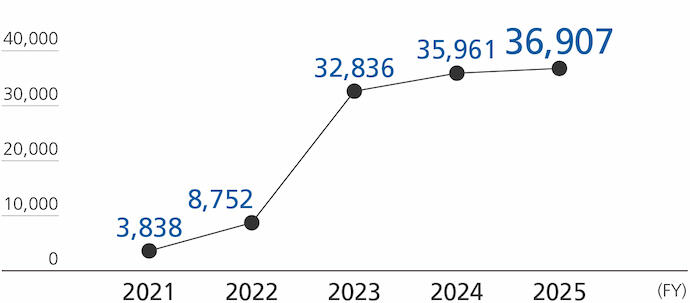
The event encompasses a varied program, from live seminars and e-learning to the distribution of reports from dialogue meetings with the management team. Also featured is the offering of a special menu at employee cafeterias, with dishes such as COCE curry, named after the code’s initials. In the fiscal year ended March 31, 2026 (FY2025), total participation in the seminar and e-learning events reached 36,000. That is around nine times the number in FY2021, the first year of the event.
Apart from the COCE Compliance Days, messages from the management team and other compliance-related materials are regularly distributed at each business site. This and other measures ensure that awareness-raising activities are not limited to business sites in Japan but extend worldwide, with each region and country devising a range of inventive initiatives.
Number of online views of seminars and e-learning content during COCE Compliance Days in Japan
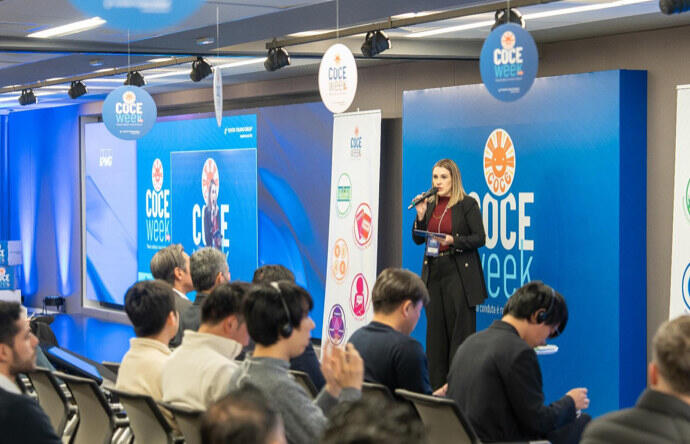
COCE and Compliance Days at our various sites
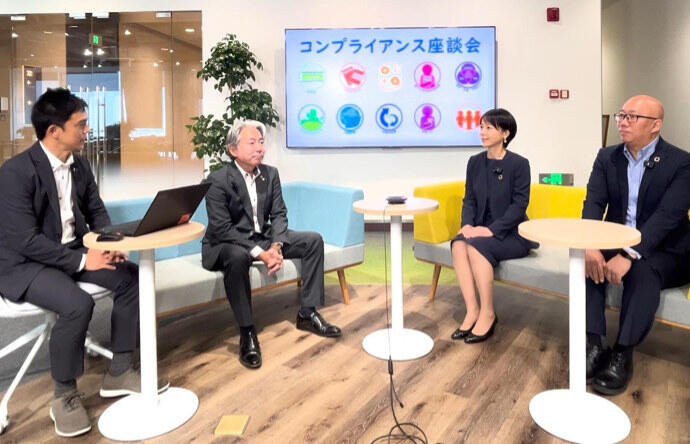
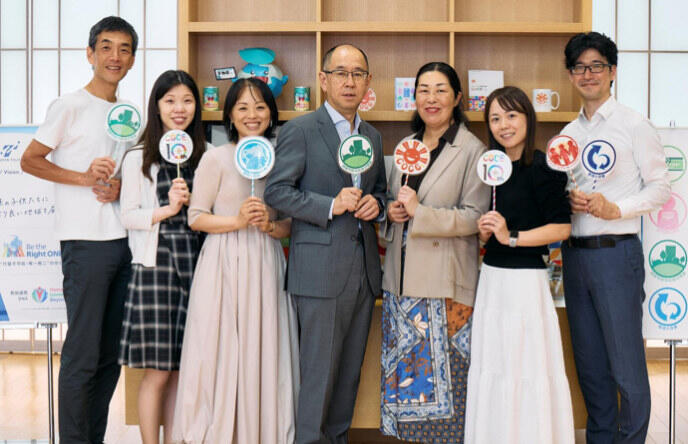
Inoue: One issue that emerged immediately after the creation of COCE was spreading awareness of it in the countries of the Asia Pacific region. As it had not been possible to have staff from all countries participate in its drafting, staff from our group in Japan visited the region themselves and assembled key staff members from each country to explain how COCE had come about and its significance. Our emphasis was on meeting face-to-face to ensure effective communication.
Fujimoto: Since then, we’ve turned our attention to other regions too, working to support local staff members engaged in promoting COCE by providing training in each country, and working together with them on training and other activities to raise awareness.
Inoue: I think one thing that drove awareness of COCE was its availability in multiple languages. After starting with 12 languages, it had expanded one year later to 18, and is now available in 23. That was possible because members of the drafting team from each country started wanting to spread COCE in their own language and supported the work of translation. Not many other companies have made their code available in so many languages.
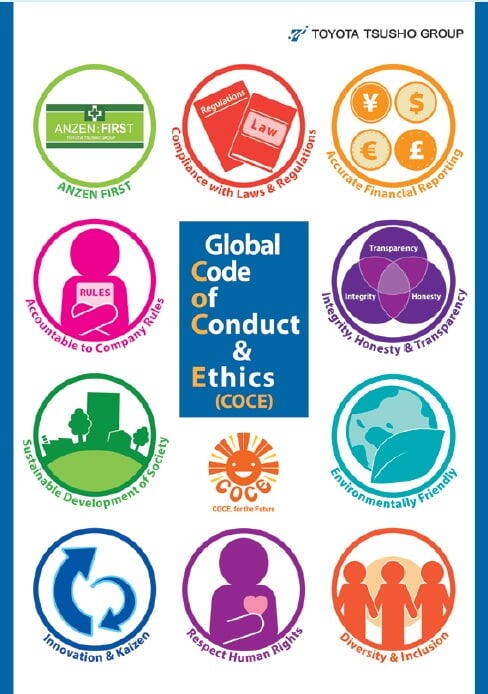
Hinoue: Apart from the translation, I think the poster that depicted COCE’s ten principles in icon form was also effective. Icons have a meaning that’s clear at a glance and can communicate to officers and employees worldwide in a way that transcends language and culture. The icons had a very positive internal reception and were useful in promoting understanding of COCE during training.
Fujimoto: COCE Compliance Days are expanding. It all started with a COCE event held in 2019 by an operating company in Brazil for just one day. Seeing this inspired us to launch a similar event in Japan. We set the whole of October as the event period to coincide with the Corporate Ethics Month of Keidanren (Japan Business Federation) and we had soon identified a whole range of messages we wanted to convey. Similar initiatives then spread rapidly to countries around the world.
What really pleased me was that this wasn’t an instruction from headquarters. Instead, staff working to promote COCE in each region decided spontaneously that they wanted to join in too. An initiative that had started in Brazil and Japan spread to India and the Asia Pacific region, East Asia, and Africa, with plans also emerging for joint events spanning different regions. The initiative has now been taken up by mid-level and younger staff inspired by the commitment of the drafting team members. Each region learns from activities in other regions while at the same time developing a distinctive character for its own event.
Hinoue: There are also increasing opportunities for staff engaged in COCE’s promotion to get together. These include the Global Meeting held every year in Japan and events in each country with Head Office staff as guest speakers. This interaction has a motivating effect and results in ever greater commitment to promoting COCE.
One thing that struck me while I was engaged in this work was a comment from our local staff in Vietnam: “These are values that have always been important to us too. We’re delighted that you’ve put them down in words as part of our shared Group values.” In contrast, some Japanese staff working in our overseas operations reacted by saying that it was all obvious stuff and asking why they needed to be trained in it at all. This was another difference in attitude that I noticed.
Inoue: The idea that certain things are obvious and go without saying may well be common to most Japanese. But when an issue does arise, I think just expecting everyone to do the obvious thing doesn’t work. Ideally of course, staff would automatically act in accordance with COCE without even thinking about it, but it’s important all the same to have COCE as a conscious reference point.
The central principle is integrity. If following fixed rules is compliance, then integrity, which values honesty and principled behavior, means doing the right thing of your own accord even when no-one is looking. If each individual working for the Toyota Tsusho Group were motivated by integrity in their decisions and actions, we could make a greater contribution to the world and come closer to fulfilling our Group Vision of passing on a better Earth to the children of the future. That’s why we call COCE our compass for the future.
Hinoue: That’s the goal I want to work for too. It’s important to emphasize compliance as a standard we have to observe, but our training and workshops and the COCE Compliance Days are designed with the additional idea of nurturing integrity.
Fujimoto: Our aim is to practice COCE in our actions as individuals and as an organization. That is true integrity. I would like to declare the next 10 years as a Decade for Putting COCE into Practice.
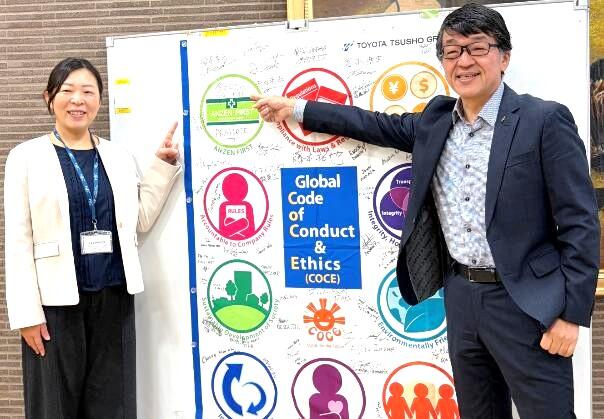
Promoting COCE is an ongoing task
Taking COCE to the next phase with the participation of our 70,000 people
We continuously update the operation of COCE in response to change in the social environment, the increasing diversity of our workforce, and the move toward stricter corporate governance requirements. In October 2025, we revised the COCE booklet and updated to a more visually communicative design.
One task for the next 10 years is to further reinforce the corporate ethos we have nurtured of independent action based on a strong ethical sense. With our aim of achieving sustainable growth as a corporate group trusted by society, we constantly implement new initiatives to promote COCE’s implementation in practice and its embedding in our operations.
Hinoue: If we want to work as part of a diverse team in a company that remains the preferred choice of customers, then we all need to follow the same compass. Especially nowadays, with the Toyota Tsusho Group constantly expanding by welcoming new member companies, I feel COCE is more important than ever.
Inoue: Up till now, whenever a new company joined the Group and already had its own code of conduct, the two codes were checked against each other line by line, and only when both sides were satisfied that they were based on the same set of values was the other company invited to adopt COCE. As the Group expands progressively over the next 10 to 20 years, I believe that COCE will continue to be the foundation for establishing a single corporate philosophy based on the same set of values.
Fujimoto: I think of COCE as the compass for what President & CEO Imai calls our “brigade of 70,000 people.” People moving forward in the same direction, thinking for themselves how to act, and then putting that into practice. That is the kind of team I want to build, one that works together in a spirit of positive motivation to promote Group-wide awareness of COCE.
Inoue: The then president & CEO sent out a message at the time of COCE’s establishment that provided great momentum for spreading awareness. “Even if it would boost our business performance, if a deal goes against COCE, then you can let the opportunity go. If you make that decision in the spirit of COCE, then you will have nothing to regret.” That is the definitive judgment he made for us all. If they consistently follow this policy, which says that COCE comes before any management instruction, officers and employees can be proud in the knowledge that they are doing the right thing.
Hinoue: COCE really is steadily growing as a priority. Before we even announce the event, increasingly people ask us what the dates are this year and what is on the program. Whenever I see people showing this kind of interest and taking the initiative in promoting awareness, I get a real sense of the change in mindset over the last 10 years.
Inoue: That doesn’t mean of course that we can step back from efforts to promote COCE. There’s a tendency to think that COCE is the same as compliance, but as you can see by reading its 10 creeds, only a small part of it is directly concerned with compliance. Beyond that, it deals with wide-ranging issues from safety, sustainability, and the environment to human rights and DE&I in a way that is directly relevant to management. I will continue working tirelessly to show that COCE ranges far wider in addressing deep questions of value.
History
| 2016 |
|
|---|---|
| 2017 |
|
| 2018 |
|
| 2019 |
|
| 2020 |
|
| 2021 |
|
| 2022 |
|
| 2023 |
|
| 2024 |
|
| 2025 |
|
| 2026 |
|