Toyota Tsusho Envisions the Future of the Global Circular Economy
February 27, 2026
Masanori Toda
Group Leader
Battery 3RG
Reverse Supply Chain Business Department,
Circular Economy Division

Kazuya Hirai
Group Leader
CE Innovation Group
Reverse Supply Chain Business Department
Circular Economy Division

Ryoji Tomida
Deputy Head, Integration Office
Seconded to Radius Recycling, Inc.
A Strength Built Over 50 Years: Supply Chain and Reverse Supply Chain
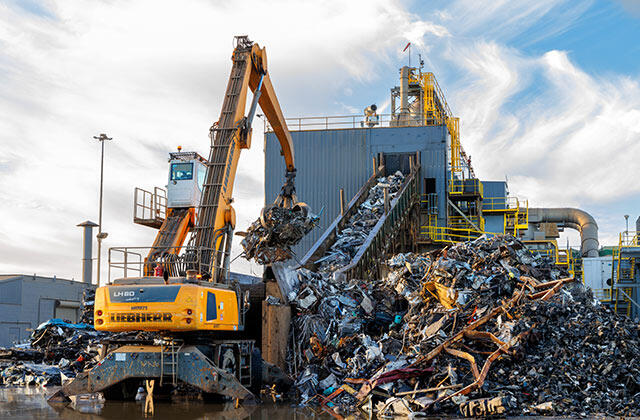
In yards where scrap steel is piled high, massive heavy machinery operates without pause as end-of-life vehicles (ELVs) are dismantled one after another. Recovered parts are reused, while rare metals extracted from automobile batteries are recycled as raw materials for new batteries.
These scenes may be unfamiliar to most people, but they represent the very frontlines of the circular economy where resources circulate and are transformed into new values.
“For us, the resource recycling business is not something out of the ordinary. Rather, it is something we have long done as a matter of course,” says Mr. Toda.
Mr. Toda serves as a Group Leader in the Reverse Supply Chain Business Department. As he explains, Toyota Tsusho has been engaged in resource recycling well before demand for recycling and material recovery reached today’s levels.
“As a member of the Toyota Group, we began collecting and recycling steel scrap or scrapped cars generated in automobile manufacturing processes in the 1970s. Since then, we have been deeply involved in Toyota Group manufacturing, remaining engaged across every stage of the vehicle life cycle to ensure that resources are utilized to their fullest.”
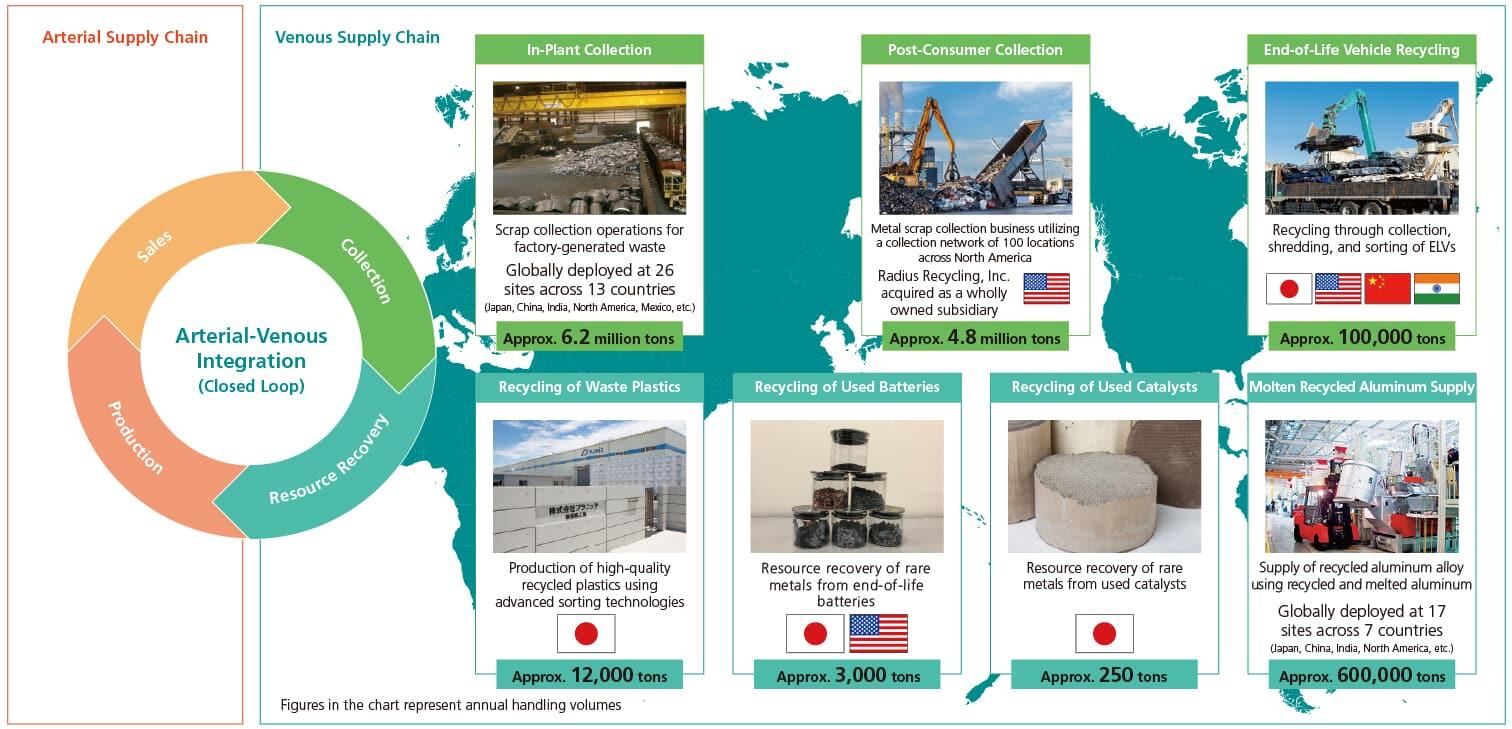
For example, metal scrap generated during new vehicle production is sorted, processed, and rigorously quality-controlled before being reused as raw materials for steel and aluminum raw materials, where it is reborn as automotive parts. From ELVs, we also recover a wide range of materials, including ferrous and non-ferrous metals and plastics, and recycle them using optimal technologies. The resulting recycled materials are returned to the supply chain as new vehicle parts and materials, supporting ongoing resource recycling efforts.
With an eye toward the growing adoption of electric vehicles, we have in recent years placed particular emphasis on EV batteries, accelerating the development and commercialization of technologies that efficiently recover rare metals from used batteries and reuse them as high-quality battery materials.
The Momentum of the Circular Economy Creates New Opportunities and Challenges
As production bases of customers, including the Toyota Group, expanded across North America, Europe, Asia, Central and South America, and Africa, Toyota Tsusho’s resource recycling network broadened alongside them.
In recent years, shifts in the momentum of the circular economy have been driven by three key factors:
1. Changes on the arterial industry side
Regulations such as Europe’s mandates on the use of recycled plastics and recycled battery materials in automobile production, along with India’s extended producer responsibility requirements, mean that arterial industries now face the reality that, without using recycled resources, production may no longer be possible, and products may no longer be viable in the market.
2. The challenge of recycling
Advancing electrified vehicle strategies requires addressing how to collect battery scrap and end-of-life batteries and return them to the supply chain. Moreover, in the case of plastics as well, a stable supply of high-quality recycled plastics is indispensable to comply with the tightening European regulations.
3. Japan’s specific issues
Of the approximately 9 million vehicles produced domestically each year, many are exported overseas as new vehicles, used vehicles, or used parts, leaving only resources equivalent to 1-2 million vehicles within Japan. As automotive OEMs worldwide set targets for the proportion of recycled materials they use, competition to secure recycled resources is certain to intensify.
In recent years, demand for recycled resources has begun to grow in earnest as regulations have strengthened and customer needs have evolved. Under these conditions, achieving stable expansion of resource recycling will require not only initiatives within the mobility field, but also collaboration and coordination across a wide range of industries.
In 2024, eleven Toyota Group companies, including Toyota Tsusho, came together to establish the cross-industry General Incorporated Association Circular Core. Mr. Hirai, who notes that “we want to demonstrate tangible results at an early stage through Circular Core initiatives and expand our circle of partners,” is one of the key figures who has long driven Toyota Tsusho’s resource recycling business.
“Recycled resources are, by nature, waste materials, and neither their quality nor quantity is stable. Even so, we have continued to provide a stable supply to actual supply chains while using these unstable materials as inputs. This is something only a trading company with a strong determination to protect the supply chain could achieve. Our long-standing spirit of constantly asking what manufacturing customers need and how best to respond has established a reliable resource supply structure that cannot be replicated.
Over the past 50 years, we have developed a supply structure and network capable of delivering the recycled resources our customers require with stability in both quality and quantity. Looking ahead, however, the market will demand even higher levels of those aspects.
That is why we believe it is essential to expand new forms of collaboration while leveraging the strengths we have built to date.”
An Ideal Partner Found in North America: Why We Chose Radius
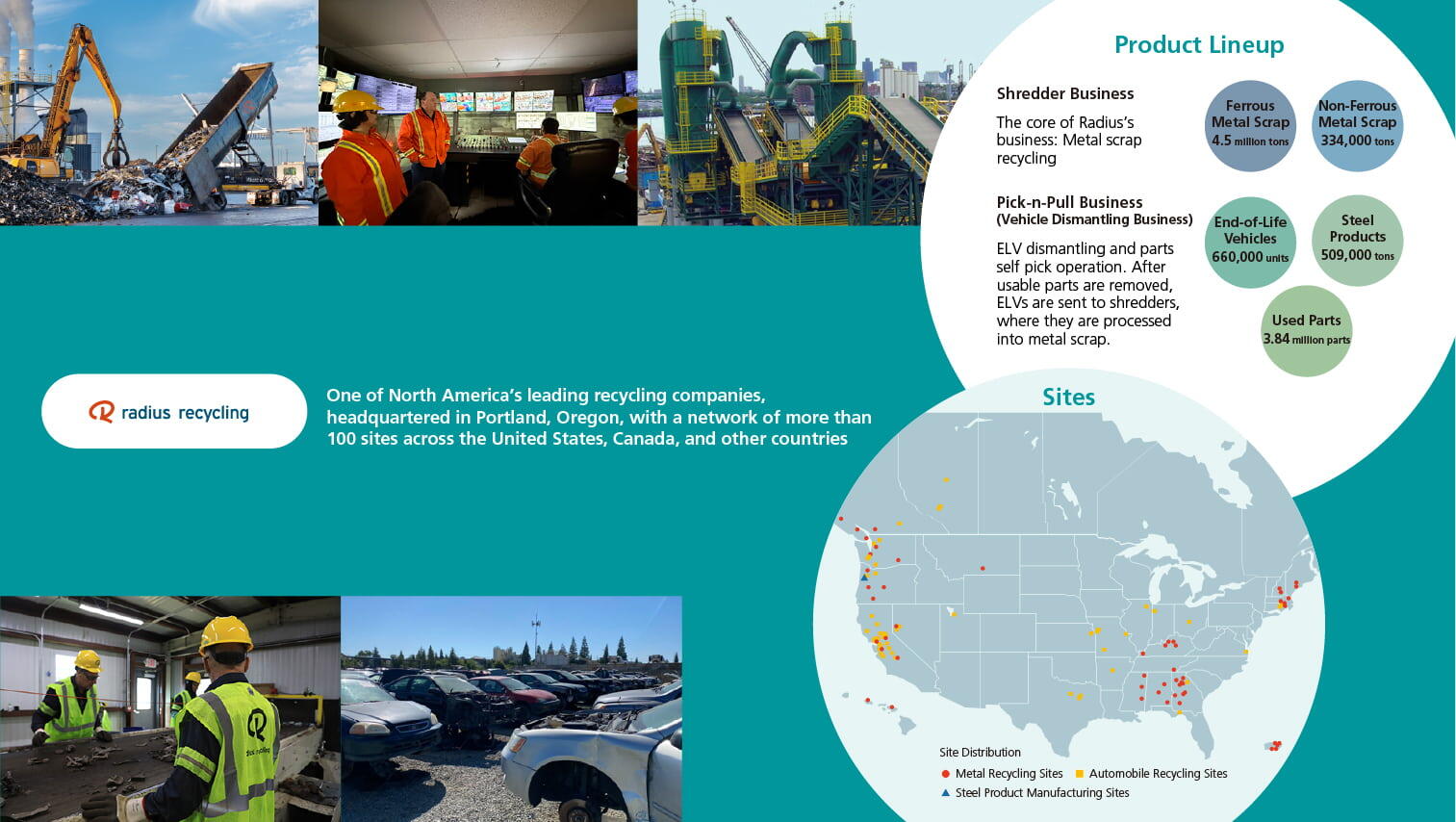
In July 2025, Toyota Tsusho made Radius, a leading recycling company in North America, a wholly owned subsidiary.
It was 2023 that we seriously began our discussions on collaboration with Radius.
Radius, a long-established company founded in 1906, is one of North America’s foremost recycling businesses, handling approximately 4.8 million tons of scrap each year. Not only collecting, sorting, and processing metal scrap, it also operates Pick-n-Pull upstream—a vehicle dismantling and used parts business—and has firmly established itself as an automotive recycler in the North American market.
Mr. Tomita, who joined the evaluation team from the initial concept phase and was involved in market analysis and the selection of candidate companies, explains the thinking behind the decision.
“In Japan, we have achieved an ELV recycling rate of nearly 99%, which is an extremely high level. To leverage this expertise and expand our business on a global scale, we believed that a broad and stable collection network was crucial. In that respect, we felt great potential in Radius.”
“The decisive factor was the similarity in our values. Radius has a set of values called ‘SSI,’ which takes its initial from the former company name ” Schnitzer Steel Industries, Inc” and emphasizes Safety, Sustainability, and Integrity. Safety, in particular, is treated as the top priority, and I was struck by the fact that every meeting starts with sharing safety topics. The way top management themselves share incidents and lessons from the field and work on improvements across all sites closely resonates with our own culture. It made me confident that we could work well together.”
As a member of the Toyota Group, Toyota Tsusho has long upheld the principles of Genchi Genbutsu and safety first. The values that Radius has cherished for more than a century are deeply aligned with those principles at their core.
Radius Driving Synergies
With the acquisition of Radius, Toyota Tsusho’s circular venous business has entered a new phase.
By combining Radius’s overwhelming collection network with the recycling functions, recycling technologies, and quality control and closed-loop construction capabilities that Toyota Tsusho has built over many years, the supply chain for high-quality recycled materials in the North American market will be further strengthened.
We are focusing in particular on maximizing synergies across three areas—metal scrap, ELVs, and vehicle-mounted batteries—with the goal of establishing a global supply hub for recycled resources.
“Five months after the acquisition, we are beginning to see new possibilities emerge following integration, in addition to the product- and service-related synergies we initially envisioned. One example is collaboration with a major U.S. steel manufacturer. Scrap collected through Radius’s network is supplied to that company, and the steel products manufactured there are then supplied by Toyota Tsusho to automobile manufacturers. In this way, we will realize a complete closed loop in North America that integrates the venous side of collection with the arterial side of manufacturing,” says Mr. Tomita.
For Future Generations—Becoming the World’s Leading Circular Economy Provider
Chief Operating Officer for Circular Economy Division
Chairman and Deputy Chief Executive Officer, Radius Recycling, Inc.
The resource recycling business that Toyota Tsusho has built over the past 50 years is far more than the processing of scrap from ELVs. What we have created is an integrated network that takes responsibility for everything from collection to processing and supply, consistently delivering recycled materials that meet our customers’ quality requirements. Transforming waste into resources and building a circular supply chain—this is our vision of what a circular economy should be.
With the acquisition of Radius, this arterial and venous integrated business model has advanced to the next level. The addition of a wide-area collection structure has established a foundation for promoting resource recycling on a global scale, positioning us to aim for becoming the world’s leading circular economy provider. By expanding our business globally, we will also establish a stable, earnings-based business model that is less affected by market volatility.
As we welcomed Radius into our Group, one thing that resonated strongly with us was the power of connection. Corporate acquisitions can only lead to constructive dialogue when there is mutual understanding and alignment between corporate cultures. Our success in welcoming a partner with a 120-year story was made possible by the on-site capabilities built over generations, creating the conditions for Radius to fully understand and align with our philosophy.
To truly bring resource recycling loops to life, it is essential that we ourselves remain deeply engaged on both the arterial and venous fronts. Working hard alongside our colleagues and striving to make society better—not for ourselves, but for the next generation—we will continue to take on challenges hand in hand with the team at Radius.