
CEO Message
My Second Year as President & CEO Demonstrated
Even More Clearly Our Great Strength in Areas of Expertise
A year and a half has passed since I became president and CEO in April 2025. Looking back, we see that the structure of society has changed dramatically, particularly due to the sudden rise in geopolitical risk and the emergence of ever more advanced AI technologies. As a result, I feel that the number of threats companies face has grown significantly. However, for a Sogo shosha (general trading company), periods of transformation such as the present offer excellent opportunities for growth, and I see the opportunities as outweighing the risks.
During Japan’s Warring States Period (late 15th–late 16th century), the tea master Sen no Rikyu wrote a famous poem which begins “On the back path where people do not go, there is a mountain of flowers.” Over two decades ago, Toyota Tsusho turned its attention to Africa, which other general trading companies paid little attention to, investing resources and launching diverse businesses. We also diverged from the industry trend by turning away at an early stage from resource development focused on “digging up the Earth” to concentrate instead on businesses that recycle existing resources or contribute to green infrastructure. I believe that it is precisely by following the path where competitors do not go that we have come to excel so uniquely in our areas of expertise. I take pride in the fact that, during my first year as president and CEO, we were able to get our new management system off the ground successfully, having redefined our business, with the distinctive strengths developed over time, as a “uniquely competitive Sogo shosha.” As we face a future of unpredictable and dramatic change, I am sure that Sen no Rikyu’s words will resonate ever more powerfully.
In the fiscal year ended March 31, 2026, we achieved 370.5 billion yen in profit for the year attributable to owners of the parent (profit for the year), making this our fifth consecutive fiscal year of record-high earnings. As we now operate our eight “distinctively Toyota Tsusho” businesses on a global scale, if one market or region suffers stagnant demand, it can be offset by success in other businesses. It is this business structure that has enabled us to set a new profit record for five consecutive years.
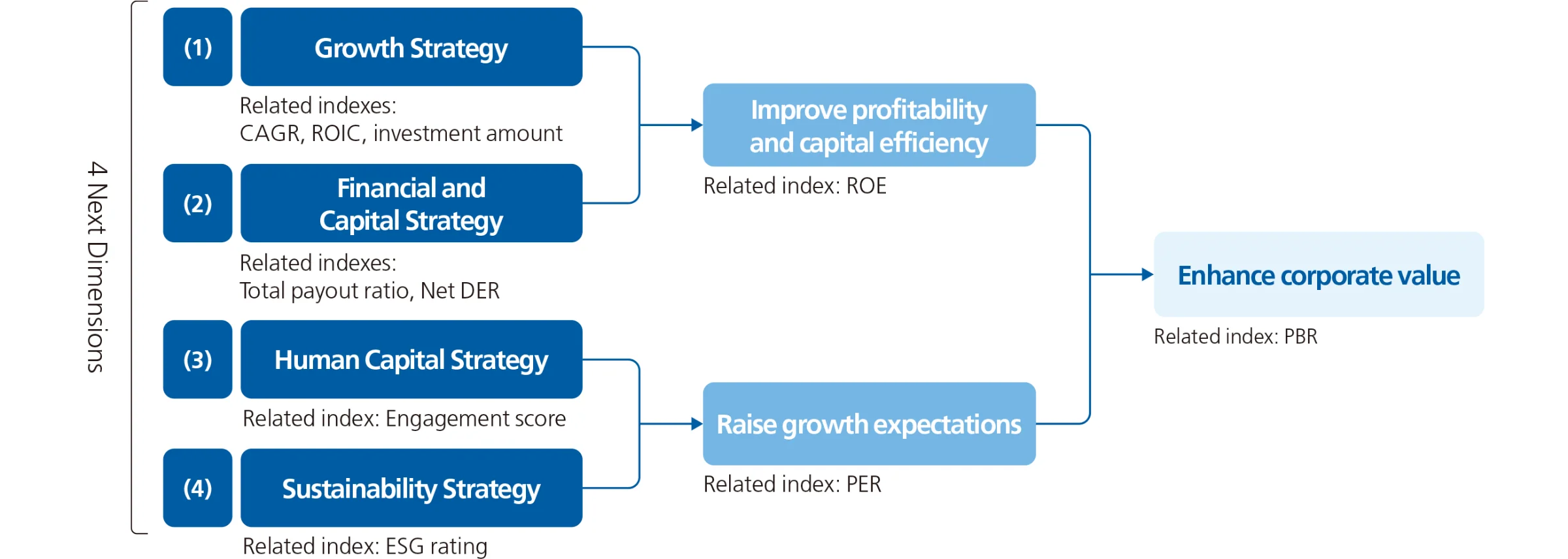
Our forecast profit for the fiscal year ending March 31, 2027 was initially 400.0 billion yen. In our first-quarter earnings results for the fiscal year ending March 31, 2027, we revised this upward to 430.0 billion yen. Meanwhile, To the Next Dimension 2028, our medium-term management plan for the period up to March 31, 2028, sets numerical targets for its final fiscal year, including raising profit for the year to 450.0 billion yen and return on equity (ROE) to 15% or above. We will also invest a total of 1.2 trillion yen in growth over the three-year period and aim for a total payout ratio of 40% or above. I believe that our strategies and measures for achieving these plan targets are generally making steady progress. Instead of a rolling format as in the past, the new plan sets fixed three-year targets. We will maintain accountability for reaching these targets, providing detailed explanations of our progress with particular emphasis on dialogue with the market. At present, one of our pressing tasks is further improving our ability to adapt to changes in the environment caused by geopolitical risks. Specifically, we must make our supply chains more resilient. Anticipating potential disruptions to our existing manufacturing and supply networks, we must accelerate efforts to secure alternative supply sources and create multiple transportation routes. Another important issue will be improving our ability to adapt to AI, which is advancing at a previously unimagined pace. We position AI as a partner, not a tool, and will work with it to build a system that realizes high productivity in each business, which will in turn heighten our competitiveness.
To the Next Dimension (1)
— Growth Strategy
Aiming for the World’s Highest Market Share
In the three years of the medium-term management plan, our aim is to raise corporate value, with specific focus on the price-to-book ratio (PBR) as an indicator. To achieve this goal, Rather than continuing to grow organically along the existing trajectory, this means raising our whole business and management to a new and higher level.
What Is the Gondwana Economic Zone?
The first step in our growth strategy consists of defining the businesses where we have especially prominent strengths as “uniquely competitive areas” and working to elevate them to the next dimension. We aim to achieve the top share of the global market, or at least the Japanese market, in each of these areas.
In the first of our uniquely competitive areas, our Africa business, we will grow our business to roughly three times its current size over the next 10 years. To do this, we are accelerating investment in the mobility, renewable energy generation, and healthcare sectors. Specifically, in the fiscal year ended March 31, 2026, we acquired a distributor business for Toyota and Hino automobiles from a local company in Ghana to turn it into a distributor directly operated by our Group. In Egypt, meanwhile, we began commercial operation of Africa’s largest wind power plant, with an output capacity of 654MW. We also purchased additional shares of Goodlife Pharmacy, a major pharmacy chain in East Africa, thus converting the company into a wholly owned subsidiary.
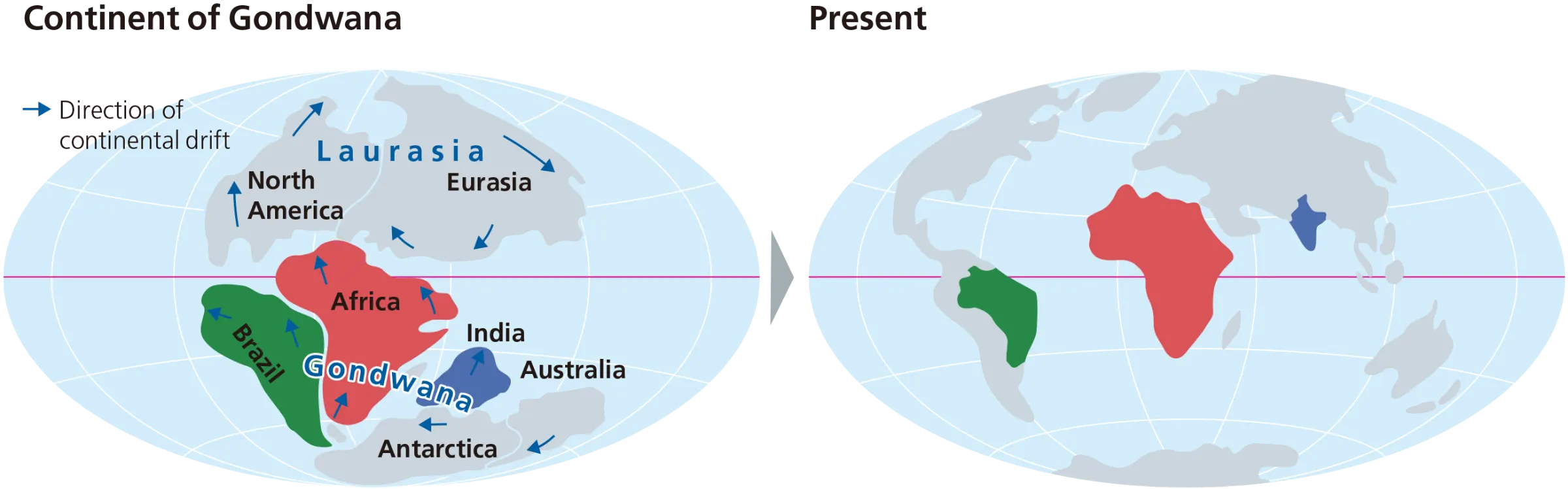
Our Group is currently accelerating investment in the Global South, drawing on the strengths cultivated in the African market, with particular focus on India and South America. With similar market characteristics to Africa, these regions offer the advantage of enabling expansion as if within the same economic zone in terms of logistics infrastructure and product strategy. It was while I was on a business trip to a port in Brazil, trying to come up with a strategic framework to cover these regions, that I was reminded that our grain is shipped to Africa too.
Looking at the map, I noticed that the coastlines of South America and Africa fit together perfectly. Long ago, these two continents and India formed one great continuous landmass called Gondwana. That is why we adopted the name “Gondwana economic zone” as a collective term for our focus markets of Africa, India, and South America.
In this Gondwana economic zone, we believe that we can achieve dramatic growth, initially in our core businesses of automobile sales and mobility services. In connection, Toyota Motor Corporation and Suzuki Motor Corporation are both implementing plans to double their automobile production volume in the Indian and South American regions by 2030. We have also begun creating a new “distinctively Toyota Tsusho” business by turning our attention to the latent needs of the Gondwana economic zone. This is what we call a and we plan to nurture it to become one of our core businesses in the near future. A model for this is our hospital operation and insurance business in India, where we are currently building operational expertise for rollout to Africa in the future. This economic zone also has tremendous potential in the field of important mineral resources. In India, we are already expanding our refining of rare-earth materials for automotive electric motors, and we also plan large-scale investment in Brazil.
No Need to Dig Up the Earth
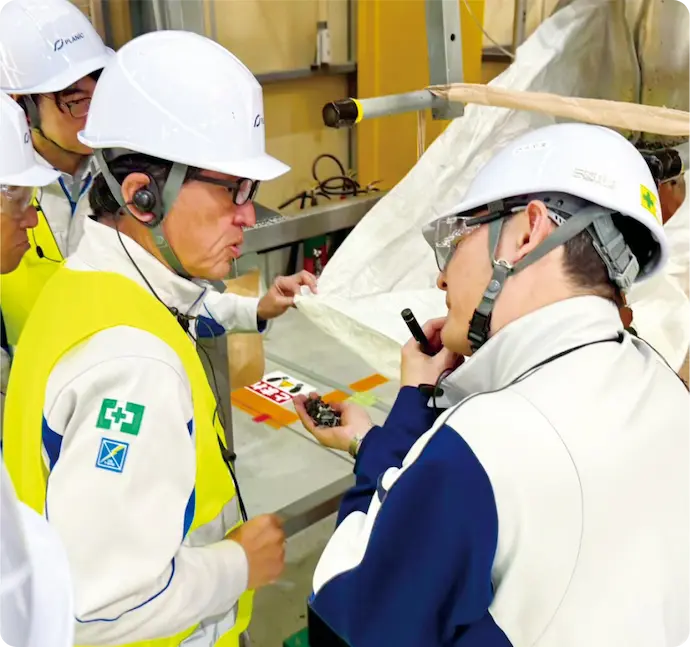
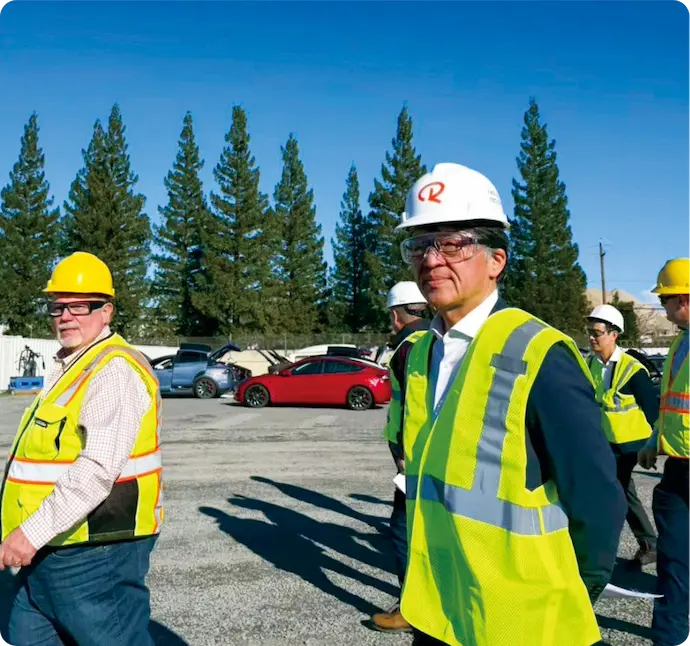
Our second uniquely competitive area is the circular economy. In the 1970s, we began business operations in the Japanese market to recover and recycle iron and steel scrap from Toyota Motor Corporation production processes and from end-of-life vehicles. For half a century, we have expanded our resource recycling network worldwide in step with the expansion of our customers’ production sites. In July 2025, we acquired as a wholly owned subsidiary Radius Recycling, Inc., a leading North America recycling operator which had been in our strategic sights for some time.
By combining the unrivaled collection network that Radius Recycling had built up in North America with our accumulated recycling expertise, we have generated a powerful synergy.
As we work to maximize that synergy, we aim to raise our global market share in base metal (iron and steel) scrap from the current 2% to 5% by the fiscal year ending March 31, 2036. For recycling in the automotive mobility domain, we expect to achieve a market share of 18% within the same timeframe. Going forward, we will extend these activities to Europe and Asia, connecting the supply chains and reverse supply chains of the mobility industry to consolidate our position as the world’s top circular economy provider. However, our aim is not simply to become the world’s No. 1 by growing our business scale. We want to establish a revenue model that turns waste into resources, thereby leading the world in putting into practice our view that ” We are already starting to produce steady results in this area, including in plastic recycling, where our materials have been adopted in Toyota Motor Corporation’s Crown “Sport” and RAV4 vehicle models.
The third of our uniquely competitive areas, the next-generation mobility business, supports the evolution of its field through electrification and intelligent technology. In the battery and semiconductor sectors, which are set to grow significantly, we will develop distinctively Toyota Tsusho strengths, working initially with partners in South Korea, Australia, and other countries to build supply chains that cover all processes from battery raw material development to used battery recycling. In the area of intelligent technology, we will use our strength in semiconductor procurement to support the development of software-defined vehicles (SDVs) and accelerate the growth of our connected services business.
In our fourth uniquely competitive area, renewable energy, we will not only carry on our existing activities in industrialized nations but also create green infrastructure in emerging countries, where energy demand is rapidly growing. We plan to expand our total power generation capacity from its current 5GW to 10GW by the fiscal year ending March 31, 2031, focusing primarily on Africa, the Middle East, and Central Asia. Within Japan, we will utilize ReEra, our integrated control system for renewable energy and storage batteries, to expand our business, which contributes to the widespread use of renewable energy and the optimization of electricity supply and demand. While there may be short- term fluctuations due to policy changes and geopolitics, we do not believe that the megatrend toward decarbonization and expanded renewable energy use will change in the medium to long term.
To the Next Dimension (2)
— Financial and Capital Strategy
Strong Focus on Cost of Capital Using ROIC as a Group-wide Metric
We also place great importance on our financial and capital strategy. As part of that, there are two things that I always aim to do in my dialogues with shareholders and investors. That means explaining in transparent and simple language why we concentrate on fields in which we have particular expertise and why we have a high market share in each of our businesses. One of the most frequent requests from shareholders and investors is to raise the total payout ratio. Under our current medium-term plan, we are continuing the policy of progressive dividends with a target total payout ratio of 40% or more, including share repurchases, for the fiscal year ending March 31, 2028. But even more frequently, our shareholders and investors tell us how much they are looking forward to future growth based on our large number of future-oriented businesses. Taking Africa as an example, over the past seven years, we have roughly tripled the size of our business. However, the real growth of the African market is yet to come. As the population expands, so will demand for automobiles, pharmaceuticals, and energy. My view is therefore that the African market is just on the eve of the kind of upturn represented by the curve in the hockey stick graph. We intend to use the network and business base that we have built so far to expand our business at a pace that outstrips the economic growth driven by population increase.
To meet these expectations for future growth, it is essential that we enforce investment discipline. In my management approach, I have consistently maintained a strong awareness of the need for value creation to exceed the cost of capital. Using return on invested capital (ROIC) as a metric to evaluate all businesses, we identify those where the cost of capital is not being covered or where growth has stagnated, and subject them to rapid review and a decision on potential business withdrawal. We also place great emphasis on the best-owner principle, so even where a business is providing a certain level of return, if it could achieve higher growth under different ownership, we will seek to divest. At the same time, we have reviewed our criteria for withdrawal and restructuring, increased the frequency of business portfolio discussions, and shortened decision-making timeframes.
During the year ended March 31, 2026, we sold all our shareholding in Toyota Industries Corporation, rendering the previously complex cross-shareholding situation within the Toyota Group simpler and more transparent.
To the Next Dimension (3)
— Human Capital Strategy
Awakening DNA to Act as a Thriving, Living Organism
As one of our four strategies for moving up to the next dimension, human capital and organization represent a critical theme. I believe that people’s innate abilities do not differ very much, but great differences do emerge as they grow older and enter the business world, depending on how successfully their latent potential is awakened. That is because of the great difference in performance that arises depending on whether people think for themselves, take an active interest in their work, and take on new challenges. That is why we have put in place a system
A typical example is our system of assigning employees to an overseas position within their first eight years, where they manage an operational department with anywhere from a few dozen to a hundred employees and are given a degree of authority and responsibility. Surrounded by people with a different cultural background and different values, and also facing a language barrier, they can find adapting to the environment a great struggle and may sometimes be overwhelmed by feelings of defeat. Eventually, however, they begin to produce results with their local colleagues. I believe that this “experiential value” stimulates great personal growth. Taking on challenges in an environment outside their comfort zone, along with the repeated experience of producing results by working with colleagues, awakens people’s dormant DNA. When they return to Japan after a number of years, they have developed as global human capital backed with an extensive grounding of experience. Many employees say that they developed new perspectives through their overseas posting. In this way, we seek to cultivate human capital with the practical ability to lead our organization’s growth.
Organizational Resilience Based on a Dynamically Responsive Supply Chain
Since 2025, our trading business has been significantly impacted, among other factors, by the U.S. government’s tariff policy. This difficult situation has reaffirmed for me what makes us strong, namely If our global supply chain is interrupted, Group business sites around the world can make immediate decisions to enable them to reorganize their supply network independently. We thus have the power to maintain our supply chain in the same way that a biological organism can repair itself. Likewise, in the event of a crisis, our business sites do not need to wait for instructions from headquarters, but can assess the situation and make their own decisions so as to be able to spring straight into action. I think is one of our Group’s great strengths. Meanwhile, with AI utilization vital to enable each of our business organizations to progress to the next dimension, we are promoting the adoption of AI-driven workstyles through initiatives led by approximately 150 committed AI influencers within the organization.
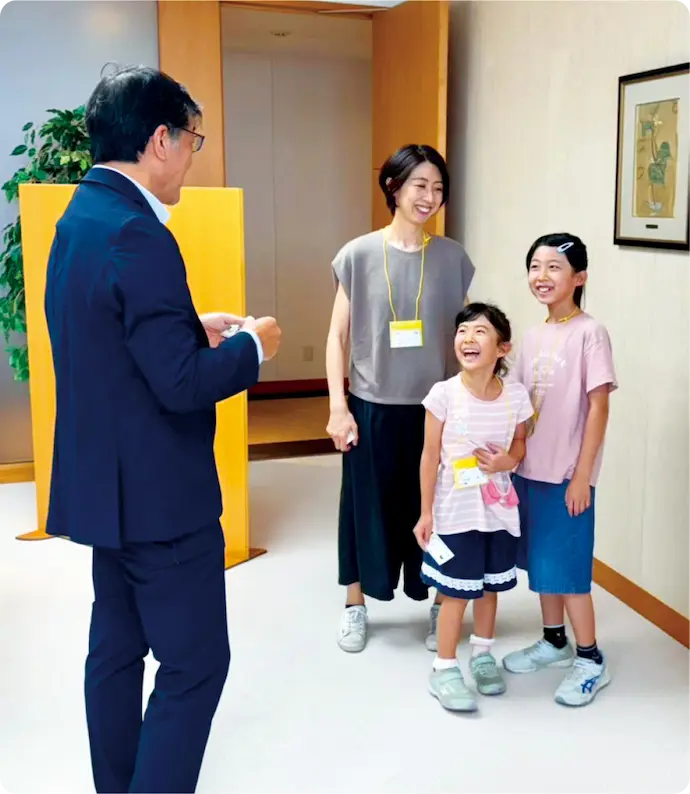
We will continue to hold these joyful events in the future. (The photograph shows family members visiting during an event.)
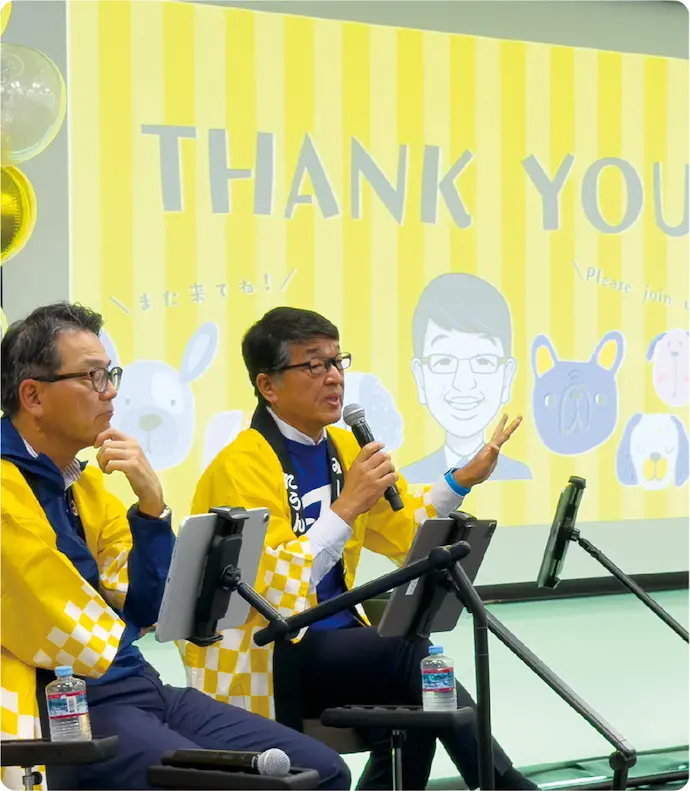
As set out above, we are making steady progress with awakening the DNA of our 70,000 employees worldwide and with creating an organization that can respond rapidly to changes in the external environment like a thriving, living organism. At the same time, we have defined a Toyota Tsusho DNA to be shared throughout the Group, and my management team and I have visited business sites around the world to hold town-hall meetings in an effort to ensure that it takes firm root. Our concern here is to engage in direct dialogue with employees. We always try to ensure that our employees, our most important stakeholders, are the first to receive any important internal information. Additionally, we hold an annual event named Welcome to Toyota Tsusho in which we invite into the workplace the family members who support our employees, and who we therefore consider to also be important stakeholders. I want these welcome events, which are full of smiling faces, to continue into the days when the children who first visited our worksites have grown up, and beyond to when these children have children of their own, the children of the future.
Creating Cross-departmental Business Projects
To help our organization continue evolving like a thriving, living organism, it is essential to further enhance coordination across internal boundaries. In trading companies, there is a strong tendency for personnel to become highly focused on their own sales division or business, but in the future We are currently working on a green data center business in Wakkanai City, Hokkaido. In this pioneering project, the first of its kind in Japan, we will directly link a wind power plant and a data center to operate servers using exclusively green power. The project is a joint operation by the Digital Solutions Division and Group company Eurus Energy Holdings Corporation, part of the Green Infrastructure Division. Going forward, we will strengthen coordination within the Group to promote the creation of this kind of cross-departmental business and thereby help create new value.
To the Next Dimension (4)
— Sustainability Strategy
From Heretical Challenger to Unique Competitor
The last of the four strategies to move our business to the next dimension is the sustainability strategy, which is designed to achieve further growth and reinforce competitiveness while at the same time continuing our initiatives, ongoing since the 1970s, to develop multiple business models that contribute to the realization of a sustainable society. Our resource recycling business, with its history of over half a century, and our wind power generation business, launched by the Tomen Corporation before its merger with our business, were at the time seen as almost heretical by the industrial world, but laterproved themselves able to address social issues while also generating economic value. Their success was due to the extraordinary efforts of the project members and to our fortune in having chosen the right time, the right location, and the right team. These businesses are now woven into the fabric of society, having moved
We are now working on a plan to add another uniquely competitive business area to the existing four, set out above as part of our growth strategy, by sowing seeds of growth in our healthcare business. With its ability to promote better health and improve the quality of life, this business has particular market potential in the Gondwana economic zone and the rest of the Global South.
Viewing we see environmental measures not as costs but as business opportunities that can be used to generate greater revenue. Related initiatives in the area of environmental management, such as climate change countermeasures, have enjoyed a positive public reception. Toyota Tsusho has been awarded the highest ranking for two consecutive years by CDP, a global ESG rating organization, and has also been continuously selected for inclusion in the FTSE group of environmental investment indices. Boosted by recognition of this kind, we will further accelerate our sustainability strategy.
Sowing the Seeds of Unique Competitiveness, the Key to Business Survival
When I look ahead at how our businesses should evolve, I become ever more convinced that a uniquely competitive profile is essential to business survival. That is why we will continue to sow competitive seeds in fields overlooked by our competitors, honing the unique strengths of the Toyota Tsusho Group as we work to elevate these projects to the next dimension. In our efforts to build unique competitiveness, one great strength is our position as which is a group strongly committed to retaining its competitive lead in industry by combining the strengths of each member to generate synergy. As the sole general trading company in the Group, Toyota Tsusho has the unique role of providing both a centripetal force that enhances value by strengthening collaboration within the Group, and a centrifugal force that reaches out to find new businesses and competitive capabilities on the outside and reinvest them within the Group.
Wanting to Pass on a Better Earth to the Children of the Future
Since my appointment as president and CEO, I have often referred to our Group as Why a “brigade”? I love travel, and For me, the beauty of travel lies not only in reaching the destination but also in the journey itself. Our Group has around 70,000 diverse employees, active in some 130 countries and regions worldwide, with around 20,000 in Africa alone. That diversity is the source of Toyota Tsusho’s strength. Our employees are all voyagers on the Toyota Tsusho ship, engaged in the mission of As we sail, we develop closer bonds with our customers and business partners. Everyone involved in the mission travels together, sharing smiles as they work cheerfully, enjoyably, and energetically. I believe that journey has great value in itself, and that is the spirit in which I use the word “brigade.”
The “children of the future” referred to in our mission are the children of the 22nd century. We have a responsibility to pass on to them a beautiful planet where people can go on living fulfilled lives into the century to come.
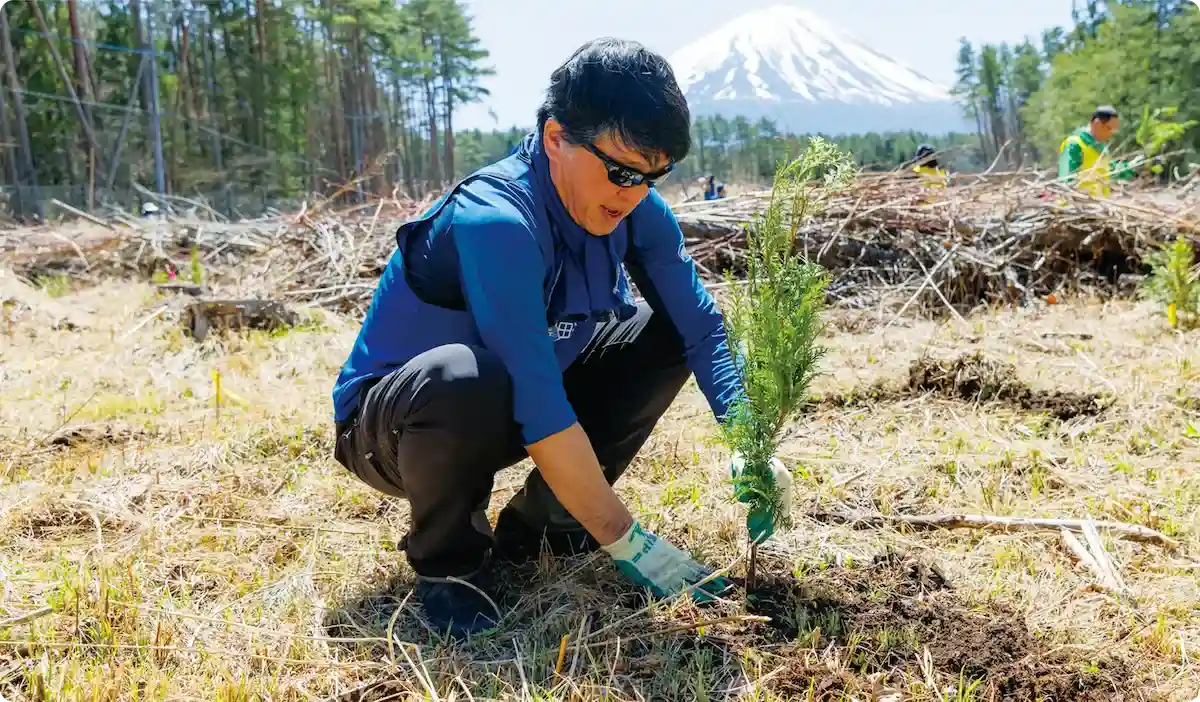
(The photograph shows President & CEO Imai taking part in forest-planting activities in the Toyota Tsusho Group Forest Project (Narusawa Village, near Mount Fuji).)