Begin everything we do with ensuring safety and compliance, and continue to be an organization trusted by society

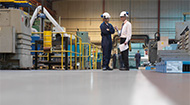
All corporate activities are supported by social trust and sustained by social confidence. Toyota Tsusho does its utmost to ensure safety at related companies and the safety of all workers. We are constantly engaged in activities that earn society’s trust and confidence, such as conducting safety education activities at plants and offices using our Practical Safety Workshop and ensuring high levels of quality that guarantee safety and (COCE) security.
In our day-to-day operations, we define specific codes of conduct for all sites and offices, both in Japan and overseas, and strictly comply with laws and regulations such as those concerned with preventing corruption or anticompetitive behavior. We are improving our management transparency and enhancing our corporate governance.
KPI
Lost work time incident rate*1, *2: Seeking zero accidents
Analysis of changes and actions taken
- Although there was a decrease compared to the fiscal year ending March 31, 2024, the ratio of accidents caused by inexperienced workers and accidents due to STOP6*3 increased. The following countermeasures were thoroughly implemented:
- Continuation of follow-through activities*4, foreman training, and follow-up activities*5
- Continued education on 18 ironclad rules to prevent STOP6*3 incidents, which can lead to serious accidents
- *1The number of fatalities and injuries resulting from industrial accidents per million hours of actual work
- *2Scope: Main domestic and overseas affiliated companies
- *3Six accidents that could potentially lead to serious disasters (“STOP6 accidents”): (1) caught-in or entanglement accidents, (2) accidents caused by contact with heavy objects, (3) accidents caused by contact with vehicles, (4) falls from height or falling objects, (5) electric shock, and (6) contact with high-temperature objects.
- *4Activities to eliminate recurrent accidents by identifying disaster themes (high-risk accidents, e.g., prevention of caught-in-between accidents, entrapment accidents, etc.) and implementing safety measures for them on a global basis
- *5Establishment of a support system at the head office for business units that require intensive support
- *6Ironclad rules to prevent (STOP6) accidents (e.g., installing fences around the machinery that possibly cause accidents, a separation of path for pedestrian and vehicles)
- Strengthening the quality of safety assurance and further improving systems
- Results
-
- Global implementation of fire and explosion prevention activities to maintain supply chains
- Company-wide implementation of e-learning and VR-based Office Safety Workshops to learn about office risks
- Construction safety supervision and factory inspections by management teams practicing an on-site, hands-on approach
- Promoting global compliance program
- Results
-
- Annual COCE pledge obtained from officers and employees of Toyota Tsusho and consolidated subsidiaries, and promotion of awareness-raising and educational activities
- COCE and compliance events held in Japan and across overseas regions, including messages from management as well as various training sessions and seminars
- Comprehensive compliance inspections at Toyota Tsusho and domestic and overseas consolidated subsidiaries
- Strengthening of the functions of the Board of Directors meeting
- Results
-
- Macro-level risk discussions conducted by board members, with a system established for regular reporting and discussion at the Board of Directors meetings
- Strengthening the emergency response capabilities of the entire corporate group to deal flexibly with increasingly severe cyber attacks
- Results
-
- Continuous strengthening measures to prevent cyberattacks and conducting initial response drills based on a hypothetical cyber attack
Based on the beliefs that safety and compliance are the cornerstones for all work and that safety management is a matter of human resources development, Toyota Tsusho conducts safety and health education not just for Toyota Tsusho Group employees but, upon request, also for the employees of suppliers.
We conduct rank-based safety and health training for new employees, mid-level employees, managers, and executives and are expanding the scope of safety and health education by conducting training for persons involved in operations at suppliers.
To heighten employee sensitivity to danger by having them experience hazardous work, in 2009 we established a Practical Safety Workshop at Toyota Steel Center Co., Ltd. The workshop offers simulations of 60 different types of hazards, including being squeezed between objects and dangers involving heavy items. Educational materials on predicting six types of hazards have also been prepared. Workshop attendance is also open to the personnel of suppliers who take part in Toyota Tsusho’s Safety and Health Cooperation Council. The workshop serves to raise awareness regarding safety and health. In the fiscal year ended March 31, 2025, a total of 755 persons, including 131 participants from 10 suppliers, took part in these workshops, and the cumulative number of participants since their establishment, including business partners, reached 11,871.
Taking into consideration that since Toyota Tsusho is a trading company and much of its work takes place in offices, in the fiscal year ended March 31, 2017, we began conducting Office Safety Workshops and taking measures to raise awareness of safety regarding office work. In the fiscal year ended March 31, 2025, approximately 100 persons participated in the program, and to date more than 1,000 participants from the Toyota Tsusho Group have attended.